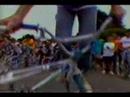
Big man rolling. Me, Steve Emig, riding backwards, with a bit of style, on my Schwinn BMX cruiser, in 2009. Remember when BMX cruisers weren't cool? Some readers of my Freestyle BMX Tales blog, from the Midwest, hooked me up with this cruiser, and some T-shirts, when I landed back east. After years lost riding, and many pounds gained driving a taxi, this was about the only trick left in my trick bag at the time.
(like usual in my blogs)
When you say "The Streets" these days, a whole lot of things may pop into people's minds. But a lot of it will probably revolve around rap, hip hop, jewelry made for maximum bling factor, and people in expensive clothes posing, wearing Supreme gear, or something like that. The other thing many people picture are rows of smelly tents with lots of sketchy looking homeless people milling around. "The Streets" is a pretty vague term, but it sounds fucking cool. Tough, urban, gritty, scary, wild.
That stereotype is why I'm kind of surprised myself that I wound up doing this blog. I grew up as a kid in rural and small town Ohio. I was listening to John Denver records and wandering the woods half the time. Some of my early memories on streets or roads involve herding cows off Route 603, outside of Shiloh, when they got out of the pasture of the farm we lived on. I was 9, and we rented a farmhouse, but the owner actually did the farming. But when the cows got out, I helped herd them back into the pasture, a little bit.
My sister Cheri, My dad, Tom Emig, and me, ready to head to church. This is about 1972, in Massillon, Ohio, I think.
A year later, shortly after we moved to nearby Willard, a new friend showed me a skateboard for the first time. His dad, a fabricator, made it out of aluminum plate. The aluminum was rolled over on the edges, with steel roller skate wheels. Months later, I had my own board, a green plastic Scamp that I bought at Western Auto for $11.92. I was learning back wheel 360's and we were tandem sit skating , our feet on each others boards, down the little hill, in front of that house on Laurel Street, where I saw that first skateboard the year before.
We moved almost every year, around Ohio, sometimes just to a new house, sometimes to a new city. My first thing to do was explore the new area on my red, white, and blue, three speed, stick shift, banana seat bike. Soon I would meet a new friend or two. Usually we were wandering around the woods nearby within hours. I was pudgy, I sucked at sports, super shy, smart, dorky, and about as far away from living a "street life" as you can imagine,
Then I got into BMX, in a trailer park outside Boise, Idaho in 1982, the summer before my sophomore year in high school. A year later we moved back into town, and I was riding the big New York canal banks, and wandering Boise, looking for little jumps and stuff to ride. BMX trick riding was just beginning to turn into this thing called BMX freestyle. There were only three of us freestylers in all of Boise. Nobody in my school new who Eddie Fiola or Martin Aparijo or R.L. Osborn was. I was the only freestyler in my high school of 1,200 kids. Pushead, the artist and skater, lived in Boise around that time, but I never met him, or even heard of him, although I saw the halfpipe he and friends used to skate. It was a no BMX scene.
BMX is what led me to really explore "the streets," although there was not much urban in Boise, except the fairly small, downtown area. But there was a cool tabletop built into the lawn of the office building next to the state capitol building. We'd hit that in 1984 and 1985, on occasion.
I graduated high school, worked at a Mexican restaurant, and hung out with my outdoorsy friends, often going fishing, doing some shooting, and trying to meet girls, like any 18-19 year old guys. I was also beginning to practice freestyle tricks on my bike nearly every day. Boise freesytler Jay Bickel, and me, did a few shows, and rode in parades in the Boise area for about a year.
Here I am, on my Skyway T/A, doing a Robert Peterson inspired balance trick. Uh... yeah, the shorts. We thought all the guys in California wore OP cord shorts. We were wrong. This is at the Boise Fun Spot, a little amusement park, where I was manager, in the summer of 1985. Photo by Vaughn Kidwell
Then my dad got a job in San Jose, California, and I followed my family down there, right after turning 19. By publishing a zine, I got to know the riders in the San Francisco Golden Gate Park scene, and the Beach Park ramp jams, held by Skyway pro freestyler, Robert Peterson. Before long, I was riding up to The City and sessioning with Dave Vanderspek, Bert, Maurice Meyer, Rick Allison, and the other locals, which included John Ficarra, Chris and Karl Rothe and Mark McKee, among other,s at the time.
On those afternoons, I'd wander down the road in Golden Gate Park and watch the skaters for a while. Tommy and Tony Guerrero and friends hit the launch ramp, blasting several feet up, and blowing my mind. I also watched Maurice's brother, Ray Meyer, freestyle skating. Within a couple of months of landing in San Jose, I was riding with those am riders to the Embarcadero after Golden Gate Park sessions, bombing down the occasional San Francisco hill, and hearing about bike and skate spots like The Dish, China Banks, and Calabassas jumps. Those guys were my introduction to "the streets" in a real, big, crazy, urban environment.
Being the uptight, complete fucking dork that I was, riding around downtown San Francisco scared the living shit out of me. But it was a blast as well. I learned that an ollie over a homeless person was called a vollie, for "vagrant ollie." I did a poll in my zine, and we settled on the term "bummyhop" for a BMX bunnyhop over a bum. And yes, I did a handful of bummyhops in the wild, following all those other riders through The City.
That was on Sundays. On most other days, I was wandering around San Jose alone, exploring on my bike, like I had done since I was about 7-years-old, in every other new town or area. But in San Jose I was looking for natural urban jumps and stuff to ride. I started to run into shady characters now and then, the occasional homeless person, and getting a little more used to the urban world of a large city.
My zine, much to everyone's surprise, especially mine, landed me a job at Wizard Publications, in Southern California, home of BMX Action and FREESTYLIN' magazines. That happened in August of 1986. Though the job was short lived, I was thrust into the BMX industry, and riding nightly with magazine guys Gork and Lew, and locals Craig Grasso, Chris Day, and sometimes R.L. Osborn. We sessioned at The Spot, by the Redondo Beach Pier nightly, and wandered off street riding fairly often.
The South Bay, as the Torrance/Redondo Beach area is known, was a new, huge, urban area to explore. I met skater Rodney Mullen on my second night in Redondo Beach, and got to know him a bit. I saw Mark Gonzales for the first time, when he skated up one night to hang with Rodney. Rodney practiced his freestyle tricks with knee pads and socks pulled up to his knees, and taped fingers, in those days. He was 19, the same age as me, but already 8 time world champion in freestyle skating. Mark "Lew" Lewman was my roommate, and he got me checking out skateboard magazines for the first time. Vert was where the money was then , Pipeline and Del Mar Skateparks were still open then. Rodney and the other freestyle skaters were the low paid, kind of dorky guys of skateboarding, if you asked vert skaters. Those guys admired the technical abilities of freestyle skaters, but vert was way cooler to most. So as I was beginning to hang around the pros and top amateurs that I had been reading about in the BMX magazines, I was also seeing some of the early street skating pioneers.
What is now called street skating was just beginning to turn into a thing in 1986, led by Gonz, Natas Kaupas, and Tommy Guerrero primarily. As a dorky BMX freestyler, working at a magazine that also covered some skateboarding, I began to learn about the hardcore skating world, checking out Lew's skate mags, and some we had at work. Rodney stayed at Steve Rocco's house while in California, and Rocco hated BMX. One night Lew gave Rodney a stack of "I (heart) BMX" stickers, and Rodney plastered them all over Rocco's place, driving him nuts. It was months before he found the last couple stickers. We all got a good laugh out of that one. Rocco was pretty much a washed up freestyle skater at the time, but within months, he would start World Industries, and dominate the skateboard industry, years later.
We were just young guys riding and skating, at a time when, even in California, you were weird if you spent a lot of time riding or skating as a teen or 20-something. None of us realized just how big street skating or BMX freestyle would become. Andy Jenkins, as FREESTYLIN's editor, and a skater, was heavily influenced by skating, punk rock, and the D.I.Y. culture that was a key part of those worlds. That influenced Gork, Lew, and me, as we started covering early BMX street riding.
I got laid off at Wizard after a few months, I just didn't click well with those guys. We got along as friends, but I wasn't the right guy for Wizard. I landed in Huntington Beach, writing and shooting photos for the American Freestyle Association's newsletter in early 1987. Some BMXer/skater kid named Spike Jonze filled my spot at the magazine. He was a good fit for the magazines, and started shooting photos a lot. That wound up working out really well for him.
Meanwhile, I found myself in a hub of surfing, skateboarding, punk rock, and BMX culture. I soon began to spend my weekends sessioning at the Huntington Beach Pier, hanging with Mike Sarrail and a couple other local freestylers. That was in early 1987. Also hanging at the pier were some more freestyle skateboarders that I became really good friends with, Pierre Andre' (Senizergues), Don Brown, and Hans Lingren. Bob Schmelzer was around at times. There was also this whole crew of young street skaters, Ed Templeton being one of the most notable at the time. Mark Gonzales lived in the area, and would come by now and then. The scene was just all day sessions every weekend. The skaters would get a crowd watching them, then the police would break it up. Then us BMXers would get a crowd, and the police would break it up. That happened every Saturday and Sunday if there, if we didn't have a contest to go to somewhere. I figured out once that I rode in front of over 140,000 people, 100 or 200 at a time, in all those years of weekend sessions at the Huntington Beach pier. We didn't put out a hat for money, it was just practice, and trying to impress girls, for us. So I got a bunch of experience as a street performer, of sorts.

This is me, doing a Shingle shuffle, under the Huntington Beach Pier, in 1987. I don't know what was going on with my hair. I was cheap, and let it grow for about 3 months, before getting a haircut.
I wound up spending more time riding with skaters than other BMXers, from 1987 into the early 90's. I would play SKATE with the skaters at the pier, but on my BMX bike. SKATE is like playing HORSE in basketball, except doing tricks. I could do backside bonelesses, no comply's (footplant to 180), wall rides, and I became the first BMXer to really get into doing nollies (nosewheelie at speed into a speed bump or small curb, bouncing up off the ground), in addition to my own, weird brand of BMX freestyle.
Like skaters, when I traveled to contests back then, groups of us would go street riding late into the night, in some other city, with the locals. At the same time, I was exploring Huntington Beach and Orange County, looking for cool riding spots. How many of you reading this know that there are 4 full pipes in Huntington Beach? Yeah, I didn't think so. They're small, 8' - 9' diameter, but they do exist. I found those, and rode them a couple of times.
While living there, Pierre Andre' gave me one of his old freestyle boards, so I started skating some, mostly when my bike was broken. Mike Sarrail not only became a great riding friend in those days, but he slowly led me into the world of punk rock. That opened me up to a whole new world of music, and he took me to clubs to see bands live. We even saw Joey Ramone at the lunch truck in front of Scream , in a sketchy-ass part of L.A. one night.
My job at the AFA led me into producing videos, which led me to a job at Unreel Productions, Vision Skateboards' video company. My boss was Don Hoffman, whose parents owned Pipeline Skatepark. I met a ton of top skateboarders working for Vison, like Gator, Gonz, Ken Park, Joe Johnson, Johnee Kop, Paul Schmitt, Marty "Jinx" Jiminez, as well as Chuck Hults, Chicken, and the other wood shop guys. I didn't know any of them well, but I did find out where a lot of backyard pools were, and went to ride my bike in a couple. When the Huntington Pier bank chain got cut and "disappeared" in 1989, I sessioned there all summer, nearly every night, with dozens of different skaters, and a few BMXers.
Vision closed down Unreel Productions in 1990, but kept me on. I started shooting a video of my own. Along the way, I met Keith Treanor and John Povah, and we all went street riding a lot, sometimes with me shooting video, and sometimes just riding. That became my first self-produced video, The Ultimate Weekend, which came out in October of 1990. Rider-made videos were still a really new thing back then, and mine was one of the first, along with those by Eddie Roman, Mark Eaton, and the Alder brothers Back East. BMX as an industry was dying, but street riding was evolving faster than ever. Every video that came out had some brand new tricks in it.
While I drifted away from the BMX industry, I wound up roommates with S&M Bikes owner, and pro racer/jumper Chris Moeller, through much of the early 90's. I also lived in the P.O.W. (BMX) House a couple of times, where guys like Dave Clymer, John Paul Rogers, Alan and Brian Foster, Todd Lyons, Jay Lonergan, Lawan Cunningham, and several others, were living cheap and riding a ton. Those guys were mostly racer/jumpers, but they were crazy, and groups of us would hit street spots pretty often. I sucked compared to the jumping skills of those guys. We had a lot of fun riding dirt and also street spots, and made trips to random ditches, and schools with banks, like Kenter and San Pedro. As BMX street riding was evolving, I was around some really great riders, watching it happen, and doing a little bit myself.

This is me, doing a double peg grind on a ledge in Huntington Beach in 1990. It's a video still from The Ultimate Weekend. What's really crazy about this shot is that this is either the 2nd or 3rd double peg street grind, in any BMX video. I wasn't a great rider, but managed to be ahead of the curve on this trick.
In 1995, I headed off on my own, away from the BMX industry and most other riders. But I rode solo, nearly every day, until I became a taxi driver in 1999. I still rode a lot until 2003, when I started working 7 days a week as a taxi driver, and began to gain a ton of weight. I also first became homeless, living in my taxi, in 1999. That led to a whole different side of getting to know "the streets." Riding around jumping curbs and doing wall rides is one thing. Sleeping alone in a taxi, in different parking lots, is a whole different thing.
My driver's license got suspended in 2000, due to a clerical error at the DMV, it seemed. And I became fully homeless, on the streets, for the first time in 2001. I finally got back into a taxi in late summer of 2003, and spent 2 1/2 more years, working 7 days a week, drivng drunk people home every night, and living in my cab. My long run of going in and out of homelessness had begun.
Check out my Pinterest page


.JPG)