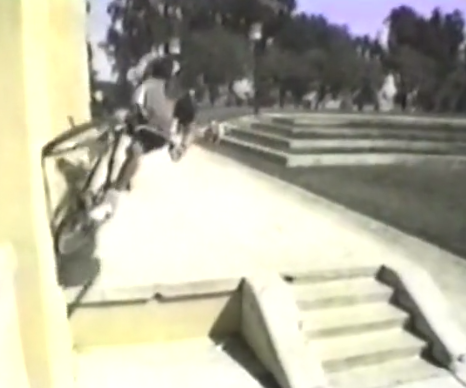
Tony Hawk, during the best trick jam at the 1999 X-Games in San Francisco. I think it was on the 11th attempt he landed the first 900 on a skateboard ever on a skateboard. He'd been trying the trick for nearly ten years.
Ride a bike, it will take you places. SE Bikes brand manager Todd Lyons says that a lot these days, and he's right. There were about 5,000 stories of Tony Hawk landing this 900, the first ever on a skateboard, that night on a pier in San Francisco, a different story for each person in that crowd. This is my version. I was standing behind the pro skaters, less than 20 feet from the side of the ramp, talking to San Francisco BMX freestyle legend Maurice Meyer. My Sony Digital8 video camera was in my hand... with a dead battery. I'm glad actually, that was a moment I was happy to just stand there and witness, without trying to capture it on video, and keep him well framed during each try. More than a decade later, in The Secret Life of Walter Mitty, Sean Penn's character sums up that feeling better than I've ever heard it described.
I had finagled a press pass to the X-Games that year, planning to write an article or two for Dig Magazine in the U.K. about the contest. Maurice had nabbed a VIP pass, too. I rode with him and the other Golden Gate Park locals, most weekends, during the one year I lived there, in 1985-86. We ran into each other near the end of the BMX vert practice, and started talking about "the old days" and how much BMX and action sports had changed over 12 or 13 years' time.
While we were talking at the bike halfpipe, a red helicopter with a World Industries logo on the side of it, hovered near the ramps, and started dropping stickers. The handful of kids around the area ran around picking them up. Then we realized that something else was getting thrown out of the chopper, little wadded up pieces of paper. Because of the breeze, most were falling on the empty BMX ramp area, where we were, not on the skateboard crowd. Someone grabbed one of the pieces of paper, and unraveled it. "It's money" they said. Suddenly all of us jaded Old School guys were picking them up, too. Mike Dominguez Jr., amped up after an afternoon of free Mountain Dew, sprinted around and grabbed 30 or 40 of the wadded up dollar bills, I think. I wound up with four of them, each with a World Industries skateboard character, like Flame Boy or Wet Willie, rubber stamped on them. We laughed at yet another example of Steve Rocco's crazy promotion methods. When in doubt, just throw money on the crowd. I literally had real helicopter money in my pocket when Maurice and I decided to walk over and watch the skate best trick jam, which had just started.
Dusk was descending on the huge pier that housed the 1999 X-Games, next to San Francisco Bay. With our passes, we just walked over and stood behind the rows of chairs there for pro skaters and their girlfriends, wives, and a few kids. In some of the wide shots in the clip above, you can see two really bright lights, that look lke stars on the video. We were right below, and maybe 20 feet in front of those lights, they were shining over our heads, lighting up the skate halfpipe for the TV cameras.
Maurice and I kept talking, as the world's best skaters tried their newest and best tricks. As I recall, Pierre Luc Gagnon was trying to land a heeflip Caballerial, as Steve Caballero himself sat 10 feet in front of me. Bob Burnquist was trying a one footed Smith Grind to revert, I believe. Other skaters were trying their "Merry Christmas" tricks, the things they could land once in a while. For Tony Hawk, that was the varial 720. About 12 or 15 minutes into the half hour jam, he landed one. Then he went back up, and just stood on deck a few minutes.
Skaters dropped in, sometimes snaking each other, to try to pull that one big trick. It was the closest thing I'd seen to "real," everyday skateboarding in a contest environment. The best trick jam was a concession to the vert skaters, who still weren't really happy with ESPN's take on skateboarding, in their 4th year of the putting on the X-Games. The big TV contest idea for action sports was evolving, as skaters got more involved and vocal about how they were portrayed to millions of viewers.
It was obvious the bigwigs at ESPN didn't give a shit about the best trick jam, but they had a big crowd, around 5,000 people in the stands on the other side of the ramp, so they kept the cameras rolling. It would make for soem good highlight clips, I think that's how they saw it. Old School skater and announcer, Dave Duncan, called the action out live from the deck. Maurice and I watched and talked.
Then Tony Hawk dropped in again, and no one paid that much attention. Until he opened up out of what looked like a over-rotated 540. We stopped talking, "Did he just try a 900?" one of us asked the other. I can't remember who said it. Tony walked back up to the top of the ramp, and did the same thing a couple of more times. The second rotation got tighter and tighter. After the 3rd or 4th try, he walked off the side of the ramp, facing us, He was 15 or 20 feet away, and we could totally see his eyes, he had the stare, the "thousand yard stare," as I've heard some call it. He was looking right towards us, but saw nothing. Pure focus. I asked Maurice, "Did you see his eyes? He's serious. He's either going to land it or go to the hospital trying." Maurice agreed.
The whole aura of the place shifted. Other skaters stopped dropping in. The skaters on the deck knew Tony really wanted the 900, and stepped back in respect. It wasn't planned. No color commentary guy had to spew stats and percentages to hype people up. The energy in the whole area changed. This was real skateboarding at it's best.
A top skater just got a taste that tonight was the night to land the unlandable trick, and Tony just laser focused on it. Everyone stopped skating after a couple more attempts. It wasn't about trophies or prize money anymore. We all wanted to see Tony Hawk progress vert skating to the next level. Tony kept trying, getting more and more determined, and closer to landing it. Dave Duncan kept talking into the mike like only a hardcore skateboarder could. This was a moment, one way or the other.
I think it was on the 7th attempt that Tony landed on the board, made it a few feet, then washed out on the flatbottom. I jumped up in the air screaming, I gave that one to him. But he didn't ride away, it wasn't clean, he wanted it 100%. He kept trying. On the 11th attempt, I believe, is when Tony Hawk landed the first skateboard 900 air, totally solid. Everyone went nuts.
If you freeze that video above at about 6;03, you'll see Maurice right behind Tony, in a white hoodie, with sunglasses. He ran up there with all the skaters to congratulate Tony. I, for some reason, stayed right where I was, 30 feet away, watching the pandemonium. The place went nuts. But I had seen that happen before, 10 years earlier, up in Canada.
Mat Hoffman's first 900, at 14:43 in this clip, in Kitchener, Ontario, Canada, in the spring of 1989. After the intro with Eddie Roman's girlfriend, this is the footage that I shot from that contest, with Eddie and friends doing their funny color commentary over it. This is from the 1990-2-Hip video, Ride Like a Man, edited by Eddie Roman.
Riding a bike did take me places. I was a dorky, unathletic kid who grew up in Ohio, spent 9th grade living in New Mexico, and then lived in Boise, Idaho through high school. The summer after my sophomore year, I got into BMX riding, then BMX racing, and then new sport of BMX freestyle, in 1983. A year after I graduated high school, my family moved to San Jose, California. I worked at Pizza Hut, started publishing a freestyle zine, and met the Bay areas freestylers, like Maurice, Dave Vanderspek, Robert Peterson, Hugo Gonzalez, and a couple dozen more. My zine led me to a magazine job in Southern California. I wasn't punk rock enough for that place, and I got laid off. I got a job editing a newsletter, which led to working at Unreel Productions, the Vision Skateboards video company, in late 1987. I was out riding three hours a night like everyone else, but didn't have the balls to make it to pro caliber as a BMX freestyler. By 1989, I was Unreel's camerman, traveling to all the 2-Hip vert and street contests to shoot video, because Vision Street Wear sponsored the contests.
While I was bouncing around the BMX and industries, the early skatepark riders inspired a bunch of great quarterpipe riders around the U.S. and Europe. In 1987, Haro pro Ron Wilkerson started putting on halfpipe contests. Riders like Todd Anderson, Josh White, Joe Johnson, and this kid from Oklahoma, named Mat Hoffman, moved up the amateur ranks and into pro. They pushed the older guys like Eddie Fiola, Brian Blyther, Mike Dominguez, as vert riding progressed.
The first 2-Hip King of Vert of 1989 was in Kitchener, Ontario Canada. The less than epic 2-Hip halfpipe was set up in a college gymnasium for the weekend, and the riders, amateur and pro, gave it their best. The talk of the weekend was that this crazy, unknown guy from Canada, called The Terminator, was going to do a backflip abubaca or fakie or something. No one except lake jumper Jose Yanez had done flips on a BMX bike then. No one had even tried them on vert. The Terminator was an amateur, and when his final run came up, he did a high fakie, leaned back a little, and crashed hard. The weekend up hype fizzled.
The rest of the amateurs rode their runs, blasting high and pulling their best tricks. Joe Johnson landed the first double tailwhip air, which was amazing. I was on the deck, with a $50,000, 35 pound, rented Ikegami Betacam, shoulder checking photographer John Ker for a good angle to shoot from. I was doing my best to get good footage of the days events.
Then came Mat Hoffman, in what I believe was his second pro contest. He won his first pro contest. At the end of his final run, with about 300 people watching, mostly Canadians, he nearly landed a 900. Mat got up, and went for it again, landing the first BMX 900 in a contest, and the first recorded 900 in any action sport. Even snowboarders hadn't pulled a 900 air at that point. I caught it on video from the deck, and Eddie Roman and another guy caught it from two angles below. Mat Hoffman, new pro vert rider and wonderkid, broke the 900 barrier in action sports, with video and photos to prove it. Word was the Mike Dominguez had landed a 900 or two on his own ramp. But there were no photos or video. Mat made it official, the 900 was possible.
By some weird quirk of fate, me, the goofy kid from Ohio and Idaho, was there to get video. And by an even crazier quirk of fate, I was in San Francisco a decade later to watch Tony Hawk do it, live, on a skateboard. The only other two people that I know were in both places were Mat and his buddy Steve Swope. But they were running the bike contest in 1999, and I don't think they were watching the skate best trick jam. I'm not sure. There may have been a couple of people who saw both happen live.
We live in a weird Universe, and really crazy coincidences happen now and then. It still trips me out that I somehow saw both of these happen live, right in front of me. Riding a bike did take me places, for the first 20 years of my adult life. I met alot of cool people, traveled around the U.S., and into Canada a couple of times.
Then I got injured, became a taxi driver, and things went into a downhill spiral. I think life wanted to kick my ass for a couple of decades to teach me some other lessons. One of the things I've learned is that there are a lot of ways to spend your time in life, and goofing around on bikes is one of the best ways. You never know where it will lead you. Ride on!
Emmett Crooms, nothing at Sheep Hills, 1999, I think.
In 2000, after 5 years of riding on my own nearly every day, but being away from the BMX business, I bought a Hi-8 editiing system, and made a super low budget, fast paced, bike video. I had been going to contests, and shooting random "lurktographer" footage, as well as going down to Sheep Hills once in a while. The idea was to make a practice video out of footage I had shot over the past few years, plus a bit from 1991. Then get a bunch of the hot young riders of the day to want to go out and shoot some new footage for a much better video, to get back into the game.
Chris Duncan, one handed tailwhip at a Core Tour event in Huntington Beach, 2000, I think.
That idea didn't work. Just before Christmas, 2000, my driver's license got suspended, which turned out to be a clerical error at the DMV. But since I was a taxi driver who had just gone Christmas shopping, that left me broke and unable to earn money. No driver's license, notaxi driving, no income. Plans screeched to a halt, and I wound up working a sketchy telemarketing job for a while. I edited this video, Animals, in 2001, and it sold about 10 VHS copies. Most of those I sold to to A-1 Bike Shop in Westminster, the old POW House local shop. I handed a few copies out. The follow-up video never got made, and I wound up homeless for a while, and finally got my license, permit, and got back into taxi driving on Labor Day weekend 2003. The taxi industry was going down the tubes, and so was my life. So my return to making BMX videos failed.
Alex Leech, wallride off the stage at Huntington Beach High, 1991.
In 2008, fate forced me out of Southern California, and to North Carolina, where my family wound up living after I moved out. I grew up in Ohio and Idaho, so I had no connection to NC, except my parents and sister's family. What little I owned then was in a tiny, 5 foot by 5 foot storage unit. I lost everything, including all my BMX master tapes, 18 years worth of raw footage, my bike (Dyno race bike), my whole BMX magazine collection going back to 1982, (including complete collection of FREESTYLIN' magazines), and all my videos and DVD's. I went into a deep depression as soon as I landed in NC, which was November 2008, as the economy was collapsing. Bad time to find a job anywhere.
The Animals video was totally lost, until Alex Leech posted a couple of stills from it a year or so ago. Somehow, one of the few copies wound up on BMX Movie Database, where you can watch today- link above (if you're really bored).
Dave Mirra, one handed toothpick over the spine at speed. X-Games qualifying comp in Anaheim, 2000.
While things didn't go as planned 22 years ago, they never really do. I was really stoked that this, my "lost" video, resurfaced. A bunch of my lost footage was in this video, though there was about 35 more hours, shot from 1990 to 2008, that was never seen by anyone. Through the rough years of the 2000's, I planned to someday make a BMX documentary from that footage.
Two or three weeks after landing in North Carolina, after losing everything from my BMX days (except my Haro brake lever keychain), I started blogging about BMX. All I had left was memories, so I started writing them down online, not sure if anyone would ever read them. That's how my BMX memoir blogging career began. At the time, there wasn't really any media in the Old School BMX community, just a lot of chatting on that new thing called social media. Luckily for all of us who rode in the 1980's and 1990's, sonce then the OSBMXR, books, and podcasts sprang up, allowing a lot more people to tell their stories from those days, which I think is awesome.
Bill Nitschke, one of the first Whoppers (bunnyhop tailwhip) to be captured on video. The Spot in Redondo Beach, 1991.
I captured all these stills, and a bunch more, several months ago, to do something with them on Pinterest, I think. They've been sitting on my hard drive. While they don't have the photo quality, or the age, of Bill Batchelor's great photos in his new book (Concrete and Smog), they are a few snippets of the BMX that happened in front of my video lense over the years.
Big Island Mike, drawing on Mat Hoffman's arm with a Sharpie, with Steve Swope checking it out. A hint at things to come, perhaps. The X-Games in San Francisco, 1999. Mat's bike and uniform got lost by the airlines, so he borrowed Rick Thorne's bike and gear. With no sleeves, Mat decided he need some ink to do Rick's jersey justice. So Mike grabbed a Sharpie and gave him some right before riding.
Dave Clymer, AA pro racer, dirt jumping pioneer, P.O.W. House O.G., and street rider with white boy dreads. Huntington High in 1991.
Curb Dogs leader and all around innovative guy, Dave Vanderspek, showing the roots of street riding, a flatland trick in a really precarious spot. 1985, I believe, this photo was in Bill Batchelor's print zine Shreddin', and has been one of my faovrite photos of his for 35 years. Photo by Bill Batchelor
The man who invented BMX freestyle, Bob Haro. Close-up mug shot at Pipleline Skatepark. Photo by Bill Batchelor.
A year and a half ago, a middle aged guy walked out into the garage and pulled out a box that had been buried behind other stuff for decades. He says his life was far from stellar at the time, and he's not sure why he decided to pull the box out that day. In the intro to Concrete and Smog, Bill Batchelor says opening that box "transported him to the before times, 1984..." when he was 13 and carried a camera everywhere. Lots of kids, even in the 1980's, shot a lot of photos. But Bill Batchelor was an really skilled photographer at 13, and he grew up near the legendary Pipeline Skatepark. His box of photos was a time capsule, to the early days of BMX skatepark and freestyle competitions, the first wave of BMX freestyle. Bill's BMX history was all of our BMX history. That box was a treasure trove of great photos of the guys who formed BMX freestyle into a sport in the mid 1980's, the guys created this thing that drew the rest of us in.
English invader who came across the pond to give the California riders a run for their money, Craig Campbell. Footplant on the face wall of the Pipe Bowl. Just a reminder, there's 8 feet of hard concrete transition below him, and four feet of vert. This was no small task in 1985. Photo by Bill Batchelor
As a diehard blogger, BMX and otherwise, now, who's online a lot, I commented on the first few photos Bill tentatively dropped on Facebook over a year ago. We messaged a bit, and I shared the good and bad side of sharing your own photos online. I also told him, as did pretty much everyone else, how epic these photos of his were. I remember saying something like, "Yeah, people will steal and share your photos, but if you ever do anything like an art show or maybe a book, that sharing is also promotion." Bill wasn't sure what to do with all these photos then, and I was one of many people who just kept seeing his photos and commenting, "These are fucking AWESOME!" or something close to that.
Obviously, Bill decided to compile the photographic treasure from that old box into a book. But not just any book. This is the guy who self-published an amazing print zine, Shreddin', when he was only 13. He spent the last year and a half making one hell of an amazing coffee table book, with this amazing collection of photos,as well as writing his own personal story of getting into BMX, and becoming that kid with the camera hanging around Pipeline, and other contests, snapping magazine quality shots, but ones we DIDN'T have on our walls 35 years ago.
Two very influential people in the early days of BMX freestyle, seen here at the AFA Masters comp in Huntington Beach, in 1984, I believe. In the front, BMX freestyler/entrepreneur Bob Morales, the guy who turned BMX freestyle into a sport, with the ASPA and then the AFA. He also founded Dyno, Auburn, and created many more projects. In the back, Don Hoffman, skateboarder turned video guy. Don's parents, Stan and Jean, owned Pipeline Skatepark, and Don was the first guy to produce multiple BMX videos, Wayne's World-style, by "borrowing" PBS TV equipment. Before Eddie Roman, Mark Eaton, and myself even thought about making a BMX video, Don had produced 7 or 8, all of which aired on local cable TV, and some became home videos, and then he headed Unreel Productions at Vision. I wound up working for both of these guys later on, and I'm proud to say that I did. Photo by Bill Batchelor.
Over the last few days, I've had a copy of Concrete and Smog to check out, thanks to Bill. I've been reading part of the text every day. Then flipping through the seemingly endless pages of new old photos. Everyone looks so young, that's what strikes me the most. I was also a zine publisher, a few years older than Bill, back in the mid-80's. But his zine blew mine away, and I honestly thought maybe I could work for him someday, back in 1985. I never dreamed I'd work at the magazines, but contributing to future issues of Shreddin' seemed possible. Maybe. Much to my, and everyone else's surpirse, I landed a job at Wizard Publications. Somehow, I never met Bill back in the day, though I had several issues of Shreddin', and I think we traded letters and zines. So I wound up hanging out, riding with, and shooting a few photos of the pros, as well. But my memories are strongest from a few years later, 1987-90.
In Conrete and Smog, Bill catches all the big names, Bob Haro, Bob Morales, Eddie Fiola, Brian Blyther, Mike Dominguez, Jeff Carroll, Woody and Martin, and many more, in 1984 and 1985. the whole sport was a bunch of teenagers and a few kids in their early 20's then. Kids having fun on bikes, not one of them thinking middle aged guys would be drooling over these photos more than 35 years later. Concrete and Smog is one of, maybe THE coolest Old School BMX freestyle product I've seen in the last few years. If you rode in the 1980's, at any serious level, you NEED this book. It's as simple as that. They're not sold out yet, but it's getting there. If you don't have your own copy enroute, hit that link above and order one.
This is just a hunch, but I wouldn't be surprised if there's a call for another run of these books, once the first copies hit Europe, the U.K., Scandinavia, Australia, and other foreign lands. I know there's a HUGE Old School BMX freestyle community across the ponds, from my own blogging and art, and once a couple guys get this book in hand, A LOT more Old School riders will want one. So order yours now, if you haven't yet.
Waaaaaay up in the Pipeline's 20 foot diameter full pipe, Pipeline local Jeff Carroll clocking in at about 10:30, pushing 11:00. Although inspired by nearby Balldy Pipe, that was 16 feet diameter. Pipeline's full pipe was four feet larger in diameter, and scary as can be to ride. Photo by Bill Batchelor.
With Bill's permission, I pulled four photos from the book that haven't made the rounds on social media, for this blog post, and in these captions, I tell you why I picked these few (plus the Dave Vanderspek shot from Shreddin' at the top). These aren't the absolute best, close-up photos, of which there are plenty in the book. These photos show the scene back then, in 1984-85, the small group of people making BMX freestyle happen as the first wave of popularity was just taking off.
Just to be clear, I mentioned above messaging Bill, and talking about ideas of what to do with all these photos when he first started sharing them. I didn't give him the idea for the book, he'd already thought of that. We were just talking about how photos get shared, "stolen" as some people see it, and the issues of creative work spreading around the web, whether you want it to or not. I just shared what I'd learned over years of BMX blogging, mostly that there was a big and really hardcore Old School BMX/freestyle community out there, online and off. I knew his photos would be a hit, whatever he decided to do with them. Having lived away from social media, he didn't realize then just how big the Old School community was, and that's what I told him about, just how stoked people would be seeing this incredible collection of photos none of us had seen before. Bill looked at his options, and did the publishing equivalent of blasting a ten foot air in the Pipe Bowl. Great job on Concrete and Smog, all the way around.
I can't write about Bill Batchelor's photos of the early days of Pipeline without a photo of the original King of the Skateparks, Eddie Fiola. The Pipe Bowl's face wall had 8 feet of transition, four feet of vert, and Eddie's about three feet above a five foot high fence above the lip. 8' 2" officially, this is from the high air contest. Bill Batchelor's photo captures the scene at Pipeline in the era that inspired so many of us other kids around the country to get into BMX freestyle. If you rode in the 1980's, just buy the book. You need it.
The iconic opening scene of the 1978 movie Grease, a musical play, first performed in Chicago in 1971, and which later scored 3,388 performances on Broadway, starting in 1972. Though it's officially called, Summer Nights," a lot of us think of this song as "Summer Lovin'" because of the repeating lyrics. John Travolta and Olivia Newton John starred in the movie. She just died a couple of days ago, at age 73.
In the beginning (1988 or 1989), there was the HBP apartment. S&M Bicycles owner Chris Moeller, and about three other guys, rented an apartment on Huntington Street, near Adams, in Huntington Beach, California. I think it was Chris, Dave Clymer, John Paul Rogers, and either Alan Foster or Bill Grad living there to start. Four riders and two bedrooms equals no privacy, cheap rent, and a ten minute ride to the beach. Not a bad set-up for young pro racers always needing money to get to the next weekend's race.
The HBP crew stepped things up in 1989 or 1990, and rented a four bedroom house, on Iroquois Street in Westminster, the city just inland of Huntington Beach. They soon dubbed themselves the Pros Of Westminster, or P.O.W's, for short. No disrespect was meant to actual military P.O.W.'s. The name came up, and it stuck. It was the first hardcore BMX house, and it became legendary in BMX worldwide in the 1990's. You can see the house in this clip of Dave Clymer in 1990 and 1991, first the backyard with the jumps, and later the front yard, with a glimpse of the front of the house at 1:15.
The P.O.W.'s were mostly pro racers, and the number of actual residents of the House ranged from 8 to 12 guys, sharing the four bedrooms, which kept rent down to about $90 to $120 a month, plus a share of utilities. Renting a normal room in a house then cost $350-$400, so living there saved residents a lot of money.
The best known residents of the POW House were Dave Clymer, Chris Moeller, Alan Foster, John Paul Rogers, Todd Lyons, John Salamne, Lawan Cunningham, Jason Lonergan, and Brian Foster. All together, I think there were 22 "official" house members, including myself, over the 4-5 year span of The House. Pretty much every traveling BMXer that came through SoCal in that era spent a night or two on the floor or couches. Any rider who spent a night there, and had a full page photo in a BMX magazine, could put it up on the living room wall. There were 147 full page photos of different BMX riders in the living room, not counting house residents, the last time I counted them.
There were so many good riders living at the POW House in those days, that BMX magazine editors and photographers would just show up at times, with three or four different articles to shoot pics for. Whichever guys were least hungover that morning got photos taken for the magazines.
It was the long recession of the early 1990's, BMX, as an industry "died" in 1989. There was hardly any money in the sport for even the best riders. We could all make at least 8 different meals out of a packet of ramen. Street riding and dirt jumping were evolving into their own genre's, and the whole idea of BMX riders making their own videos was just getting going. The POW House was dirty, crazy, stupid, awesome, and hated by "Miss Iroquois," the neighbor across the street. We were a bunch of young, single, BMX guys with drinking problems, or a bunch of drinkers with a BMX problem. It sort of depended on what day you showed up. Suave, sophisticated, clean cut, and respectable, we were not.
Into this house of mayhem, the current residents and former residents would gather each night, in the living room, in the early evening. We were looking for really cheap places to go party, drink, and try to meet women. On one of those nights, I was sitting on one of the four couches when "Summer Nights" from Grease came on the TV, and the volume was set pretty loud. For Genreration X kids like us, the movie Grease was etched in our brains, though none of us would ever admit it.
Within the first few bars of "Summer Nights," two or three guys started humming along. Now I'm talking guys in BMX T-shirts, thrashed shorts, with billy goat 90's goatees, and holding Mickey's bigmouth beers. We were the polar opposite of Broadway musical fans. But within 30 seconds, every single one of us was singing along with this song. Guys sang the Greasers parts, other guys sang the girls parts, in bad falsetto. We were all dancing around, acting it out, like it was the most normal thing in the world. This song was such an ingrained part of growing up as a 70's 80's kid, that we just all rolled with it, singing like a bunch of idiots, and loving every minute of it. It was seriously one of the craziest, funniest moments I remember of the POW House.
Then the song ended, and we were back to being 10 or 12 dirtbag BMX guys, deciding whether to go to see T.S.O.L., Clawhammer, All, or whatever the punk show of the night was, or to a bar with cheap pitchers of beer. As soon as the song ended, I just sat there looking at everyone, thinking, "did that just happen? Yeah. it happened. That's how big Grease, and Olivia Newton John and John Travolta were to our generation. Even punkers sang along to "Summer Nights," if no one was watching. Another random night at the P.O.W. House. "Lawan, hurry up! We gotta get there before 10 or pay full price!"
Rest in Peace Olivia Newton John.
For those looking for a little BMX nostalgia, or who have never heard of the P.O.W. House, here's the P.O.W. video that never got made, in the form of a blog post. "You are (Fo)R(G)otten."
Tommy Guererro's classic part in Bones Brigade II: Future Primitive. This part, that seems so basic now, inspired me to spend dozens of long Saturdays and Sundays wandering the South Bay area of Southern California in 1986, and thousands of hours of BMX wandering after that.
"200 years of American technology has unwittingly created a massive cement playground. It took the minds of 12-years-olds to realize its potential." -C.R. Stecyk, the quote seen right at the beginning of Tommy's section (above).
For me, it really started with the New York canal in Boise, Idaho, when I was starting high school. My family moved to 909 East Saratoga drive, in Boise, in June of 1981. That subdivision was known as Centenial at the time. If you pull that up on Google maps, the street view photo shows a hill rising behind the house. The New York canal, a big, concrete canal, with about 45 degree walls, runs along the top of that slope, allowing water to flow from just below Lucky Peak reservoir to farmland near Lake Lowell, nearly 30 miles away.
The next summer, as I've mentioned many times in previous blogs, my family moved to a trailer park we called Blue Valley, out past the Boise airport. My parents' plan was to save money for a year or two, then buy a house and finally settle down, permanently, in Boise. In that trailer park, in 1982-1983, I got totally into BMX, and started racing.
The first part of my parents' house plan actually worked. A year later, in June of 1983, we moved back into town, back to the Centenial area, to 4029 Morningwind. Again, the big New York canal was close by. In the winter months, the canal was usually dry. I could ride a few blocks, push my bike up the steep canal bank hill, and ride in the canal. I would roll in one wall, carve up the opposite wall, and bunnyhop near the top, and pretend I was Eddie Fiola, Brian Blyther, or Mike Dominguez, riding Pipeline Skatepark, like the photos I'd seen in BMX magazines. That was the first "street riding" I really did.
Later I would ride into downtown Boise, and wander around looking for stuff to ride. There was a perfect tabletop jump built into the lawn of an office building right next to the state capitol building. A couple of us would come racing around the corner, hit the table, and do a little kickout or turnbar tableltop attempt, and then ride off. We'd come back a minute later to hit it again, and usually the security guy was running out the door to chase us off at that point. There was also a little skate ditch near the BMX track, where we would do kickturns. "Street riding" wasn't a thing yet in BMX, it was just part of the random riding around I did, often with one or two of the local racers.
Over the next year, I got more into trick riding, which was starting to be called "BMX freestyle." The Haro Freestyler, a bike made just for freestyle, came out. In 1984, I met Jay Bickel and Wayne Moore, who had the only trick team in Idaho. Wayne retired, at the ripe old age of 17, and I joined the team. I started doing shows and riding in parades with Jay, and sometimes with a few of the racer guys, who could do a few tricks. BMX freestyle became my thing. I graduated from Boise High School in 1984, and bought a Skyway T/A, with red Z-rims, my first "real" BMX bike, with my graduation money. I continued to ride around the streets, finding little jumps or banks here and there, to do tricks on, like pretty much every other BMXer everywhere at the time.
In the summer of 1985, my dad got a job in San Jose, California, and my family moved there. I rented a room in my best friend's house, and worked my summer job, managing a tiny amusement park called the Boise Fun Spot. In August, when it closed for the season, I packed up my ugly, brown, gigantic, 1971 Pontiac Bonneville, and drove solo to San Jose.
While I had an old handmade skateboard that I bought in Ohio for $2, and actually did skate now and then, I had no idea what was going on in the real skateboard world at the same time. In the 25th anniversary Thrasher magazine coffee table book, there's a photo of Mark Gonazales, with a caption that says something along the lines of, "In 1984, Mark Gonzales jumped off the side of a ramp (1:55), and things got gnarbuckle." Street skateboarding was starting to morph into its own thing, apart from vert/pool and freestyle skating. Leading the charge were Mark Gonzales from Southern California, skating for Vision, Tommy Guerrero from San Francisco, skating for Powell-Peralta (and the Curb Dogs), and Natas Kaupas from SoCal, skating for Santa Cruz.
Issue #1 of FREESTYLIN' magazine, featuring a cover photo of Ron Wilkerson, riding in Golden Gate Park in San Francisco, shot by Bob Osborn.
Also in 1984, the first issue of FREESTYLIN' magazine came out, edited by one Andy Jenkins, BMX racer, art student, and skater. Andy was a fan of Thrasher, and a talented, emerging graphic artist, and helped bring the punk rock and street inspired vibe to BMX freestyle. That was something Dave Vanderspek and the Curb Dogs were already doing. A few issues into the magazine, in the April 1986 issue, came the first "street" riding article. The tricks were pretty simple, though Rick Allison's 5 foot backwards drop-in was insane at the time. All of us freestylers around the world, who devoured every issue of FREESTYLIN' (you can read it here), started looking at the urban landscape in a different way.
I started my zine, San Jose' Stylin', mainly to meet the other BMX freesytlers in the area, since I was new to the area. Within a month I met the incredible John Vasquez and his friends in San Jose. They told me about the Beach Park ramp jams, held at the bike shop where Skyway team member, and Master of Balance tricks, Robert Peterson, worked. At my first jam, I met Bert, Dave Vanderspek, Maurice Meyer, and several other great riders. I got to know Menlo Park local, John Ficarra. Not long after, I started catching rides with him and several others to the Sunday afternoon jams in Golden Gate Park, up in San Francisco.
In Boise, I was one of the only fish in a really small pond that was BMX freestyle. Suddenly I started riding with these amazing riders, pros and amateurs alike, from the Bay Area. We often went to the Embarcadero after the flatland sessions at the park. Embarcadero was this place with big, blocky ledges and steps, you can see Maruice Meyer and others riding it at 3:27 in the video below.
Ride Like a Man, the 1990 2-Hip video, produced and edited by Eddie Roman. The first few minutes are a good look at street riding when BMX freestyle was "dying," as the first wave of popularity of the late 1980's ended.
Not only did I see Tommy Guerrero and other skaters blasting off launch ramps in Golden Gate Park in 1985, but I was riding with the Curb Dogs, Dave Vanderspek, Maurice Meyer, and others, who were leading the charge in BMX street riding at the time. They got me looking for more urban riding spots. A few hours of riding at the park, and downtown San Francisco with those guys, and I would drive back down to San Jose tired, but totally psyched to ride as much as I could all week.
I worked the evening shift at Pizza Hut about 5 nights a week, usually getting home around midnight or 1:00 am. I often worked on my zine and did balance tricks in my room until 3:00 or 4:00 am. Then I'd crash out, wake up around 10:30-11:00, have breakfast, argue with my mom about something, and do whatever household chores needed done. In the afternoons, I would go ride for two or three hours. Sometimes I would practice flatland in a nearby parking lot. But I began to start wandering on my bike more and more, looking for urban places to session. I wandered all over the San Jose area looking for banks, little jumps, ledges and benches to footplants on, and anything else that looked fun to ride. Riding on the weekends with the Curb Dogs/Bay area riders inspired me to spend more time just riding around, exploring. On my days off from work, I would sometimes ride around for 7-8 hours, into different areas.
I found the Calabassas jumps (the dirt jumps in this clip), I bombed down the hills above Mountain View, chasing road bike guys at 40 mph. I wandered over to Cuppertino, and explored the edges of downtown San Jose at times. With the influence of the Curb Dogs, my riding expanded from just spending hours learning flatland tricks, to riding around and just having fun on my bike. There were very few other freestylers in 1985-86, but I ran into a few now and then. Mostly though, I spent a ton of time solo riding, both practicing flatland, and wandering and riding street obstacles.
It's impossible now to describe just how weird BMX freestyle (and street skating) were in the mid-1980's. All of us older Gen X kids grew up in a world where there were four "real" sports. Those were football, baseball, basketball, and hockey, and all were on the three channels of TV when we were kids in the 1970's. To "play sports" back then meant having an overweight coach, with polyester shorts and a whistle, yelling at you for two hours a day, at practice, and making us do windsprints. Then a handful of the good guys would play in the game, while the rest of us sat on the bench. At the end of the game, whther we played or not, one team was "winners" and one team was "losers." If you made the best play of your life, but th team lost, you were still a loser for the week. If you played like shit, but your team won, you were a winner that week. Forsome of us who were not natural athletes, that shit never made sense.
In BMX, we just went out on a "little kid's bike" and did whatever the fuck we felt like doing, just having fun. We pushed each other naturally, nobody had to push us to improve, we pushed ourselves and each other. The funny thing is, action sports, like BMX freestyle, andskateboarding, just keep evolving, where traditional team sports get a kind of rigor mortis, solidifying into set rules and ideas. They were fun to play at times, but BMX and skating were much more fun for us weirdos of that era.
After close to a year living in San Jose, my zine, much to mine and everyone's surprise, wound up landing me a job at Wizard Publications, home of BMX Action and FREESTYLIN' magazines, in August of 1986. I hopped on a plane down to L.A. with my bike, a suitcase, and $80, and started a new life. I had just turned 20 years old, and a week later I was proofreading two magazines that were published worldwide. I moved in with Gork and Lew, two of my co-workers, sleeping on their couch for a couple of months, in Redondo Beach, until we found a three bedroom apartment. Once again, I found myself in a huge metro area that was new to me. I soon began wandering around on my bike on the weekends, exploring the South Bay area of Los Angeles county.
Nearly every weeknight we sessioned at The Spot, on the north side of the Redondo Pier. Usually it was Lew (:56), Chris Day, Craig Grasso, and Gork most nights. A couple of times a week, R.L. Osborn, would come down and session, and industry guy McGoo came by occasionally, sometimes with CW riders Ceppie Maes and Dizz Hicks. There were solid flatland session every night. Lew introduced me to freestyle skater Rodney Mullen there, who skated by The Spot when in town, and I even first saw Mark Gonzales there once, skating with Rodney. Once in a while we'd go ride the Fatburger Banks, or another street spot, bu tmost nights it was lots of flatland practicing, with some goofing around.
On the weekends though, that's when I really started going on some all day exploration rides on a regular basis. If there wasn't a contest somewhere, it was a solo day for me. I would wake up around 7 or 8 am, and make a huge plate of pancakes. Then I'd put on the Bones II video above, Future Primitive, and watch the whole thing. After that, I'd grab my bike, and take off in one direction or another. It was a 4 mile ride to our offices in Torrance, and there were some street spots along that route I started along that route, wandering off to new areas. Some days I would head up or down PCH (Pacific Coast Highway), which is a big surface street in that area. There was a 5 sidewalk section curb jump on PCH, right by Redondo Beach Boulevard, it was about a 20 feet jump, that we'd hit on our way to work. Twenty feet is a long jump off a curb cut, and we usually landed back wheel on the 4th of 5th section, with our front wheel near the landing curb cut. One Sunday morning, hauling ass on the sidewalk along PCH, I got the light, and hit the jump with more speed than usual, and cleared the long gap. I only did that twice. Bombing down 190th street hill at speed, on the border of Redondo and Hermosa Beaches, blocks from our 2nd apartment, was another thing we often did.
My best street spot find in Redondo Beach, though, was rediscovering what came to be known as the Jinx Bank. One day I was driving the Wizard van to a photo shoot with Windy Osborn, our photographer, and Haro pro Ron Wilkerson. We went to a sketchy, ellpitical transition quarterpipe behind a bike shop, where Ron debuted the abubaca. Windy shot the sequence, and Ron changed vert and street riding forever, with one photo sequence. On the drive over, I got a glimpse of a cool looking bank behind a nearby building, and then rode back a couple of weeks later, wandered around a bit, and found it.
Hidden behind a business was a little parking lot that sloped steeply down. There was an asphalt bank up against the back of the building, which went from flat to about three feet high, to over six feet tall on the end of the bulding. Wall rides had not been invented yet. But I found that it was a blast to hit the big end of the bank, then fly up, footplant on the wall 3-4 feet above the bank, then drop back into it. The first three times I went there, I broke bike parts twice, and Lew rolled his ankle the time I took him. He said, "That banks a jinx, I'm not going back." It became known as the Jinx Bank, and I rode it nearly every weekend while I lived there. But the Jinx Bank gained its own fame a year later when Windy shot this photo below of Eddie Roman there.
The first wall ride photo in a BMX magazine. Eddie Roman, once again leading the way on street, at the Jinx Bank, putting walls into play for the first time. This photo changed BMX freestyle forever. Eddie was one of my favorite riders, especially on street. He just kept coming up with new tricks, somtimes dorky, sometimes super hard tricks, always pushing the limits and progression of BMX.Windy Osborn photo, 1987.
I was really an uptight dork in 1986, and I didn't really click with the crew at Wizard. So I got laid off after 5 months there. I paid my rent for a month, and stayed home, calling around looking for other BMX jobs. Then I'd go riding all day with Craig Grasso. We rode all over the South Bay, hitting the few local ramps, street spots, and just having a blast in general. After three weeks, I lined up a job working for Bob Morales at the American Freestyle Association (AFA), and moved to Huntington Beach a week later to be editor/photographer for the AFA newsletter.
Another new area, a new job, and more weekends of wandering on my bike. I quickly started hanging out at the H.B. pier, with the local freestylers and freestyle skaters. But I also went exploring on my bike, finding the known local spots, and some new ones of my own. I found Hidden Valley (28:12), which has always had a few BMX jumps, the banks that used to be along Goldenwest Street, Huntington Beach High, Mesa View elementary (big skate spot), and when Josh White came down once, we found the Blues Brothers Wall. Over the many years since then, I rode the whole length of the Santa Ana River ditch, which has lots of hips and huge banks the whole way. Mike Miranda showed me the jumps above where Sheep Hills is now, and I found the ditch below. I even stumbled across the moon. Really, there's a park in Costa Mesa, right off the river trail, where there's a huge concrete moon surface. A couple of the craters on it are big enough to skate on, a little bit. Not much fun on a bike, but a weird find, nonetheless.
Moon Park, in Costa Mesa, California. Photo stolen off the web.
Over the 20 years I was riding my BMX bike almost every day, a lot of the best times were just the long, rambling, solo, exploration rides. I jumped 25 feet off a hip in the Santa Ana River ditch (I shot video to check the distance). Yeah, I am definitely not known for jumping, but it was a spot where someone like Chris Moeller, Dave Clymer, or Brian Foster could probably jump 35-40 feet, landing on the huge banked wall. I also did 100 foot long framestands on the banked walls of the river ditch, and even did short ones on a 60 degree banked wall I found in H.B. (destroyed in the 90's). I rode with Ed Templeton at Huntington High, and sessioned the H.B. Pier bank for months when the chain was cut, opening it up to bike and skate sessions again in 1989.
Looking back, I wish I would have shot some video of some of those sessions. But I lost all my video footage (and master tapes) in a move in 2008, so it may not have made much difference. But all those sessions, usually solo, wandering around and looking for places to ride, led to some great riding spots, and just a lot of fun days of riding. This is an aspect of riding nearly everyone has done at some point. But we never really think about it. Yet a lot of the great street spots were found by riders, often not the top riders, who just wandered around and found cool places that were not designed to ride or skate, but lent themselves to great sessions anyway.
During all those years of solo exploration, I also ran into a lot of graffiti and street art, homeless and other people in urban settings, and met other riders and skaters. Once in a while, like when I rediscovered the forgotten Jinx Bank, you find a spot destined to become legendary in our world. These are some of the best times of my life on "the streets."
The last trick I learned, in 2003, was doing nollie 180's (curved nosewheelie into a gnarly speed bump, to a 180), in a parking lot in Garden Grove where no one else ever rode. It's actually less than half a mile from the Van's skatepark in Orange. I'd nollie the speed bump every time I rode by, and stopped to learn nollie 180's one day. Soon after I went back to taxi driving, and was soon working long hours, seven days a week. I started gaining a ton of weight, and haven't ridden seriously since. I'm working now towards getting back on track financially, which will allow me to start losing weight, get a decent bike, and get back to riding daily, at some point.
So that's a look at the usually ignored part of street riding, actually riding around aimlessly, and just exploring behind, around, under, over, and through urban places, to find new riding spots. Maybe I got you psyched to go do a little exploring yourself.
I ran into a rider named Lucas Borzio at Sheep Hills in about 2000, and he wanted to check out some street spots. So took him to Huntington Beach High. I shot some video of him for a while. Then I pulled the crash pads off the high jump pit, and started doing front flips off my bike into them. That was something I'd learned while working on the crew of American Gladiators, in 1993. I'd pedal as fast as I could, jump over the bars, and fly, doing a long flip. The pads are ten feet long, and I was landing at the beginning of the second one. In this photo, I'm about 8 feet past the bike, upside down. The kid in the back is some local kid who was wandering around, and watching Lucas and me ride. This is a still from my 2001 video, Animals.
This is the full video of The Ultimate Weekend, my 1990, self-produced BMX freestyle video. This was the 8th BMX video I produced or edited, and cost about $5,000 of my own money to produce. It sold about 500 copies in the U.S., through a sketchy surf video distributor, and I sold him the foreign rights. I think he sold quite a few more overseas, but I have no idea how many.
This video idea actually started in 1986, when Andy Jenkins, my boss at FREESTYLIN' magazine, asked us other editorial guys if we had any ideas to produce a FREESTYLIN' magazine video. Bob Osborn, aka "Oz," forked out a reported $40,000 to produce a video of the BMX Action Trick Team in 1985, Rippin'. While it was well produced and had good riding, it didn't sell well, and lost a bunch of money. So in 1986, if we mentioned video to Oz, it brought back bad memories.
In that era, when you wanted to make a video, you hired a professional video production company, usually the kind that made TV commercials for local businesses, and industrial videos. A mid grade professional camera could run $10,000 to $20,000 then, and a mid level editing system could run $50,000 to $100,000 or more. "Broadcast quality equipment, like the local TV news and networks used, were much more expensive. VHS home video cameras were still relatively new, and VHS editing systems weren't available. To produce a decent quality video in 1985, you had to hire a pro team, and they were expensive. Those teams didn't have a clue about BMX, so when they made this video for the BMX Action Trick Team, they did it in the traditional documentary style, with lots of cool close-ups, visually interesting shots, and a lot less riding than videos today. While the video had great riding for its day, it just wasn't super exciting to BMXers. In addition, a 30 minute VHS video could easily sell for $30-$40, retail price A 1985 dollar is like $2.67 today, so paying $30 then for a 30 minute video back then is like paying about $80 today, for a video we could watch for free on YouTube, or stream for $9 a month from a service. So that's the other reason they didn't sell a ton of those videos, they were really expensive for that time.
So when Oz thought about videos in 1986, he thought of a big expense with little return. But times were changing in video technology, VHS cameras were falling in price, and the smaller Video 8 camcorders were just becoming available. It was the very beginning of the D.I.Y. video era. A friend loaned Gork, the BMX Action editor, and my roommate, a video 8 camcorder. Gork, assistant editor Lew, my other roommate, and me shot a bunch of BMX riding, and goofy little comedy ideas with it. Gork edited a compilation, by tying it to our VHS VCR, and made a pretty cool home video. It was entertaining enough that Andy got the idea to pitch Oz with the idea of producing a FREESTYLIN' magazine video, shot partly with Gork's camera, which would save a lot ton money in production costs. So Andy called us other three editorial guys into an after work meeting, and asked us to come up with ideas for the video.
My idea was simple, just follow our real life. We spent our weekends going to contests and BMX events, or riding with some of the best riders of the day. So in my concept, we would get off work one Friday night at 5 pm, and wander around riding with all top pros, on flatland, ramps, and maybe pools, all weekend. Then we crawled in, tired from a great weekend of riding, back to work Monday morning, the end of the video. Since we worked at the top freestyle magazine, and we all rode ourselves at some level, we did that anyhow. The video would be us magazine guys having the ultimate weekend of BMX freestyle fun. The other three guys promptly shot down my idea. Their ideas were more exciting, and a couple sounded like they could be a cool video. As things worked out, the idea never got pitched to Oz, and no FREESTYLIN' magazine video was ever made, except Gork's homemade video, which I'd love to see today, if it still exists.
I got laid off a few months later, I just wasn't the right fit at Wizard Publications, and a couple months later they hired 17-year-old Spike Jonze. He was the right guy for Wizard then, I went on to become editor at the tiny American Freestyle Association, or AFA. The AFA was three people in a small industrial unit, in Huntington Beach, and we put on the local and national BMX freestyle contests at the time. There were about 3,000 members of the AFA, and they all got the newsletter I edited every month.
A few months into that job, Bob Morales, my boss, had me produce a 30 second TV commercial to air on local MTV, for a national contest in Austin. Local commercial spots were cheap then, something like $25 each. The commercial we not great, but pulled some more people to come check out the contest. I later went on to produce six contest videos for the AFA that year, 1987, shepherded through the process by the people at Unreel Productions, the Vision Street Wear video company. Vison sponsored our contests, and sent a cameraman to all the nationals, and part of the deal was that both Vision and the AFA could use the footage. They did the editing for our videos, and I logged the footage, and picked the shots, and made sure the videos got made.
After working on several AFA videos at Unreel, they hired me, when they needed extra help. From December 1987 to early 1990, I was basically a production assistant at Unreel. WE made all the videos needed for the Vision empire, which included Vision, Sims, and Schmitt Stix skateboards, Sims snowboards, and Vision Street Wear clothes. Unreel had about 8 people, four of them producers, and I was everyone's assistant. I spent most of my time making copies of video footage for people across the Vision group of companies, and running to pick up equipment or supplies.
Unreel was weird as production companies go. Most production companies then were centered around one TV series, or made super cheap home videos. Unreel was living off the crazy profits that Vision Skateboards were making during the 80's skateboard boom. We shot a lot of footage, and then tried to figure out what to do with it afterwards. We produced all the trade show videos, commercials, and random footage that promotions, the art department, or another department might need. The company put out several home videos of skateboarding, snowboarding, BMX freestyle, and body boarding, like these: Psycho Skate, Snow Shredders, Freestylin' Fanatics, Barge at Will, and Mondo Vision.
Unreel also put out a syndicated TV series of six, one hour shows, called Sports on the Edge. Action sports rarely got on TV in the 1980's, and usually only as a quick news segment. ESPN didn't want to touch that series, though they had aired a couple earlier skateboard shows. The quote from the suits at ESPN in 1989 was, "Nobody wants to watch skateboarding on TV, and what the hell is snowboarding?" Unreel Productions was ahead of the curve.
Unfortunately, in 1989 and 1990, skateboarding faded in popularity, the third big wave of popularity crashed, and Vision Street Wear went down in popularity, and BMX pretty much died. The corporate money pulled out of those sports, and the business dropped dramatically. While the Sports on the Edge series aired nationwide on local stations, thanks to our syndicator, and got good ratings, there wasn't money to do follow-up series the next year. Instead, Vision dissolved Unreel in early 1990, and one woman and me, the two cheapest people on the payroll, were moved to the main Vision building. She quickly found another job in Hollywood, leaving me sitting alone in a big office, with very little to do.
I didn't really like the videos Vision was putting out. There were pretty cool, but a little hokey, with older skating or riding, not the most current stuff. Even though BMX freestyle had collapsed as an industry, the riding was evolving as fast as ever, particularly street riding. The first well covered street contest was in the 2-Hip Meet the Street in the Spring of 1988, less than two years before. I bought an $1,100 S-VHS camera on credit, and started shooting my own footage on the weekends in early 1990, just going wherever sounded interesting. The idea of The Ultimate Weekend concept was still in my head, and that became the theme for this video.
Initially, GT rider Jess Dyrenforth, who lived in Huntington Beach then, was going to be the main rider that the video followed from spot to spot. But Jess was getting into inline skating then, which was still surging. So when I called Jess to go ride and shoot video, he was usually busy. A couple months into shooting, I met John Povah, an English vert rider living in H.B., and Keith Treanor, an unknown and super hungry rider, who had just moved to town from New Jersey. Keith didn't have a job at the time, and was always down to go ride, and he ripped wherever we went. So Keith became the standout rider of the video, with John close behind. My flatland riding buddy from the H.B. pier, Mike Sarrail, went most of the places on the weekend, usually driving. Mike was a really good flatlander, but didn't like being in the video.
Little by little, word got around, and we went all over southern California, from the P.O.W. House backyard in Westminster, where guys like Chris Moeller, Dave Clymer, and John Paul Rogers lived, to the local jumps at Edison High school and Magnolia in Huntington Beach, to the Tijuana Skatepark, Mission Trails near San Diego, and the Nude Bowl, way out by Palm Springs. There were no skateparks in southern California then, and street spots and backyard ramps were the main riding areas.
I shot video from February or March of 1990 until the beginning of September. I quit Vision out of boredom in July, but was immediately hired to drive their dually and ramp cross country on a three week skateboard tour. As soon as I got back, I flew myself to Indiana for a 2-Hip halfpipe contest, and shot footage at Bob Kohl's halfpipe, in Chicago, on that trip. I also met my music guy, Jon Stainbrook, in Toledo. He was a guy in a punk band who could get music out pretty cheap, from several Ohio musicians, Jon's house was a waystation for touring punk rockers, and he knew everyone in that world. He and his guys even recorded two songs that I wrote the lyrics to, for the video. While I was visiting him, The Stain was the stage band for comedian Howie Mandell, back when he had hair. I was a roadie for that gig, and got to meet Howie. The guitar and bass playing at the end of the video, with Jeff and Mark, is from backstage at the Howie Mandell gig. The shot of Jon is out front of the theater, in Ann Arbor Michigan, as I recall.
I paid $1,000 out of my own pocket to rent a 3/4" editing system, in the back of a video store in Redondo Beach, and spent 5 long days editing this video. I actually paid for the music (OK, I still owe Jon $400but I paid for most of it), because I was afraid of bootlegging music and getting sued.
The thing to know about this time period is that regular people, BMX riders, didn't make videos then. BMX companies, like GT, BMX Plus! magazine, and Bully Bikes, made videos. Only a couple riders had made super cheap videos. Eddie Roman had put out the super low budget BMX movie on video, Aggroman in 1989, and Mark Eaton had put out Dorkin' in York, and Dorkin' 2, which I think were edited with two VHS machines, in that era. I hadn't seen either video. There were only a handful of BMX company made videos coming out at the time, like 2-Hip's Ride Like a Man (produced by Eddie Roman, with a bunch of contest footage I shot while at Unreel, at the end), and the Bully Slow Ride video were the main two. Crazy as it sounds today, magazines still ruled as the BMX media, and videos were just starting to be a serious thing. Everyone kept asking me why I was making a video, since it wasn't for a bike company. "I want to make a video that shows the real riding we do everyday," was my best answer. No helmets while riding flatland, no balance tricks on a miniature golf courses while wearing leathers (like BMX Plus! magazine videos), just what I thought of as "real" riding.
Because of that, every video in that era had a lot of firsts in it. The Bully Slow Ride video, for example, had Mike Krnaich pulling the first tailwhip jump. 2-Hip's Ride Like a Man had the first 900 air by Mat Hoffman, and the first street peg grind on a rail, along a walkway. I think Dennis McCoy pulled that. In The Ultimate Weekend, I had several BMX video firsts as well. Keith Treanor did the first handrail slide down steps. I had the first the mini ramps in a BMX video, the H-Ramp, skaters Primo and Diane Desiderio's backyard ramp, and Mouse's ramp near San Diego. Keith and Gary Laurent did the first riding over a spine ramp at Primo and Diane's , in a BMX video, followed later in the video by Jess Dyrenforth, Chris Day, and Mike Tokemoto riding the big spine at Mouse's ramp. Keith did the first 360 over a spine, followed minutes later by Gary Laurent. John Povah did the first ice pick grind down a street rail, the small rail at the Regional Pool. I was the first guy to have BMX footage of The Nude Bowl, an abandoned nudist colony out in the desert, with a pool that was already legendary in the skateboard world. Along with Keith, John, and myself riding, I got skatepark legend Brian Blyther to come out and ride there, along with former Pipeline local Xavier Mendez. I also had Mike "Crazy Red" Carlson doing the first tailwhip jump over a set of doubles in the video. He dragged a foot on the landing, but rode it out. There are a few more tricks that were firsts on video in BMX, most technical tricks.
I also managed to get several top 80's pros in the video, like Martin Aparijo, Josh White, Todd Anderson, Ron Wilkerson Woody Itson, Pete Augustin, Jess Dyrenforth, Bob Kohl, and my personal favorite, Eddie Roman. This was the first video to get footage of pro racers and top dirt jumpers, Chris Moeller, Dave Clymer, and the P.O.W. House (Pro's of Westminster) backyard. Even the now iconic S&M Bikes shield logo was first seen in a video here, spray painted on the side of a VW bus as I walked into the P.O.W. House backyard.
BMX freestyle, the initial explosion of the 1980's, with helmets and motocross style leathers being standard attire in contests, was fading after its first wave of popularity. Street riding and dirt jumping were just turning into their own genre's, and riding was going underground, into what became the long, ramen-eating recession, of the early 1990's. "BMX is dead" we were told, but us hardcore riders wouldn't accept that, and kept riding anyway. We didn't know what the future held for BMX freestyle.
As it turned out, Chris Moller's tiny garage company, S&M Bikes grew during the recession, and Hoffman Bikes, Standard Bikes, Eastern Bikes, and FBM were all rider owned bike companies, started during that recession. Most of those, possible all, got their bikes built in the U.S., by the time the recession ended. Even ESPN came around, near the end of the recession, and started the Extreme Games in 1995, changing the name to the X-Games a year later. BMX, other action sports, and TV finally merged in a big way, and BMX freestyle exploded into its second big wave of popularity, with rider owned companies and rider-made videos now at its core.
Eddie Roman, Mark Eaton, myself, and the Alder Brothers, who produced our own rider-made videos in 1988-1991, had no idea what we were doing at first, and no idea we would spawn a movement. By 1993, every fledgling company was making their own videos, with Hi-8 video cameras and "prosumer" equipment making video production possible for everyone willing to do the work of shooting, logging, and editing videos.
The Ultimate Weekend was not a blockbuster video like Eddie Roman's later videos,Headfirstwith Mat Hoffman (1991) and Ride On (1992). But everyone who rode then saw this video, at some point, and it had the best production quality of the rider made videos when it came out, in October of 1990. Us early video producers in BMX freestyle, skateboarding, and snowboarding, made the kind of videos we wanted to watch, and the way we made our shot and edited our videos, crazy as it was, changed the TV and video production industry to some extent. More action shots, showing people land tricks fully, close-up shots with wide angle lenses, riding skateboards with the camera to follow riders for tracking shots, and fast editing, and raw, punk rock influenced, DIY editing, and crazy comedy bits, all rippled into other productions in the years since.
I started working on The Ultimate Weekend not sure I could actually produce a video on my own. Just getting a finished video that was "pretty cool," with fresh, innovative riding, was my goal. I did accomplish that. I sucked at sales, so I didn't sell a ton of them, but the distributor did pretty well with them. All in all, I lost about $2,500 making the video. While this was not a monumental video in the history of BMX freestyle, it was solid for its day, and I'm proud to have it on my reel, as they say in video production. In the years after, I went on to produce and edit the first two videos for S&M Bikes, Feel My Leg Muscles I'm a Racer (1991), and 44 Something (1993). I also stumbled into TV production work, and wound up as a crew guy on American Gladiators. Just over a decade later, I self-produced another video, Animals, to try and get back into the BMX world. It didn't really work, though I did a better job putting the video together. So that's the basic story of The Ultimate Weekend. in my Freestyle BMX Tales blog, I tell about some of the sessions for T.U.W. in more detail, starting with this post, and going back, earlier in the 2016 posts.
I totally wanted to do a 20 year anniversary follow-up to The Ultimate Weekend in 2010, but life was super sketchy then, and it didn't happen. Same thing goes for a 30 year anniversary video in 2020, I just couldn't make it happen. I'd still like to do The Ultimate Weekend II at some point. But it'll be a while longer. Maybe along while. We'll see. I need to get my personal situation stabilized first, and that's a whole different issue. Will it happen someday? I hope so.